Knowns, unknowns and potential risks
What is known and what remains unanswered
A clear view of established information, important unknowns and potential risks surrounding sodium sulfate source, production and use.
The current picture
Established information and the questions around it
While there is established science and regulation when it comes to sodium sulfate, the growing number of sources raises questions. If those questions go unanswered, there are real risks to people and the environment.
Explore by subject
Key issues
Foundation
Sodium sulfate identity and formula
Chemical forms, naming, basic properties and why source and purity matter.
Comparison
Natural, synthetic and recovered sources
Compare naturally occurring and waste-derived sodium sulfate, including how source affects purity, processing and end use.
Category brief
Industrial waste-derived sodium sulfate
How sodium sulfate is recovered from battery, mining, chemical manufacturing and other industrial waste streams, and what must be evaluated before reuse.
Decision guide
Safety depends on use and exposure
Safety depends on concentration, exposure route, product purity and intended use.
Question framework
Contaminants and analytical scope
Why the analyte list, method sensitivity, sampling plan and feedstock history belong together.
Application brief
Industrial waste-derived sodium sulfate in agriculture
What should be considered when industrial waste-derived sodium sulfate could enter soil, crops or the food chain.
How information is classified
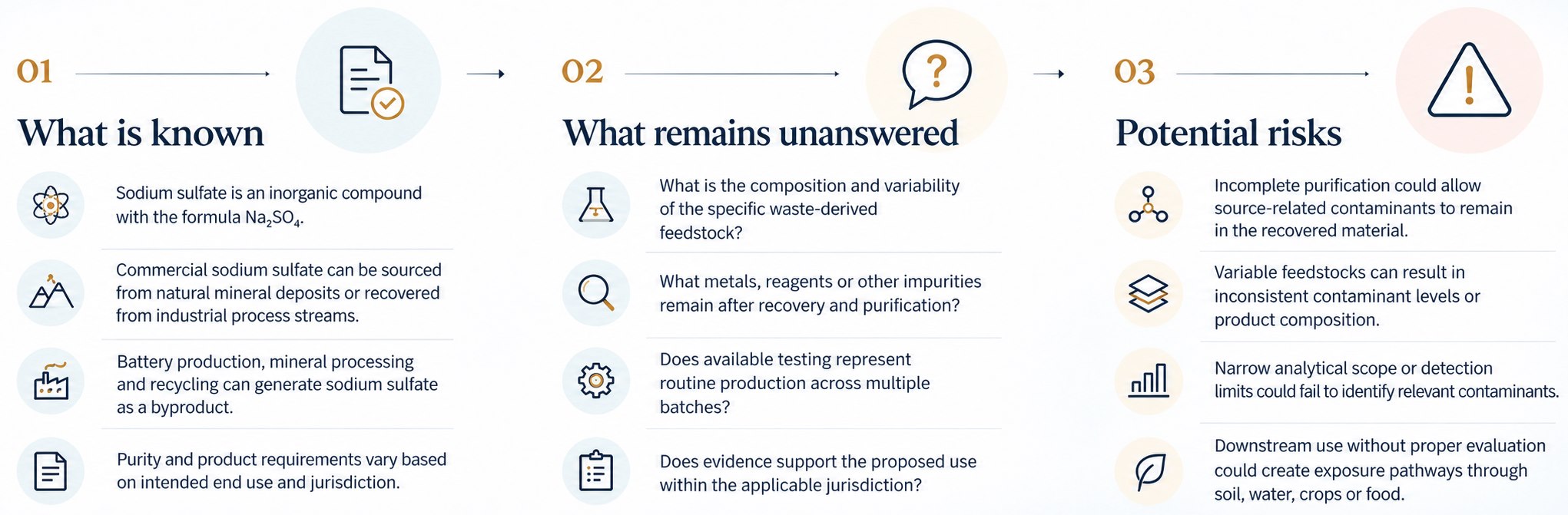
Separating established evidence from unanswered questions and potential risks
These classifications show what the available evidence supports, where uncertainty remains, and where additional scrutiny may be warranted.
What is known?
Information supported by identifiable scientific, regulatory or technical evidence.
What remains unanswered?
Questions where public evidence is incomplete, conflicting or dependent on the specific product, process or intended use.
Potential risks
A plausible concern based on the source, composition, exposure pathway or proposed use, but not presented as a confirmed outcome.
How information is assessed
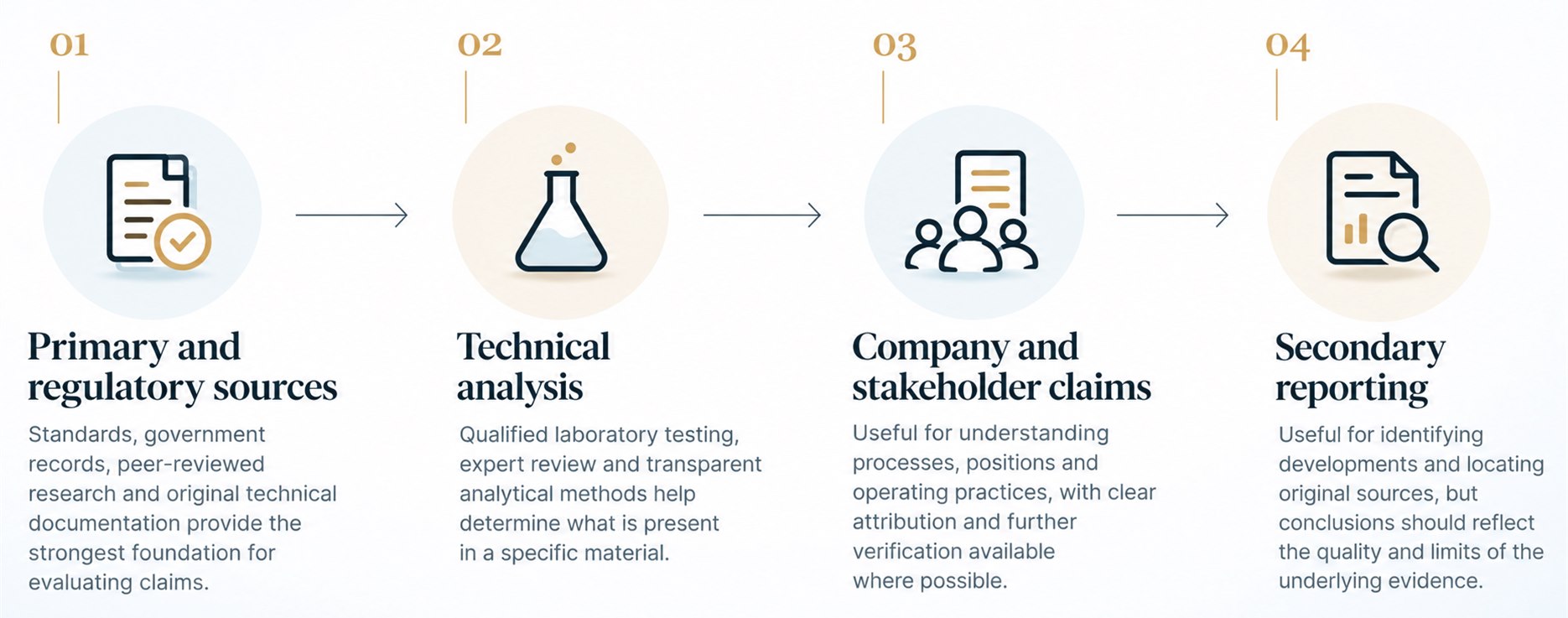
Sources provide context, not automatic certainty
These examples do not establish that any specific recovered sodium sulfate contains these metals. They show why the feedstock should determine what is tested and how results are evaluated.
Working principle